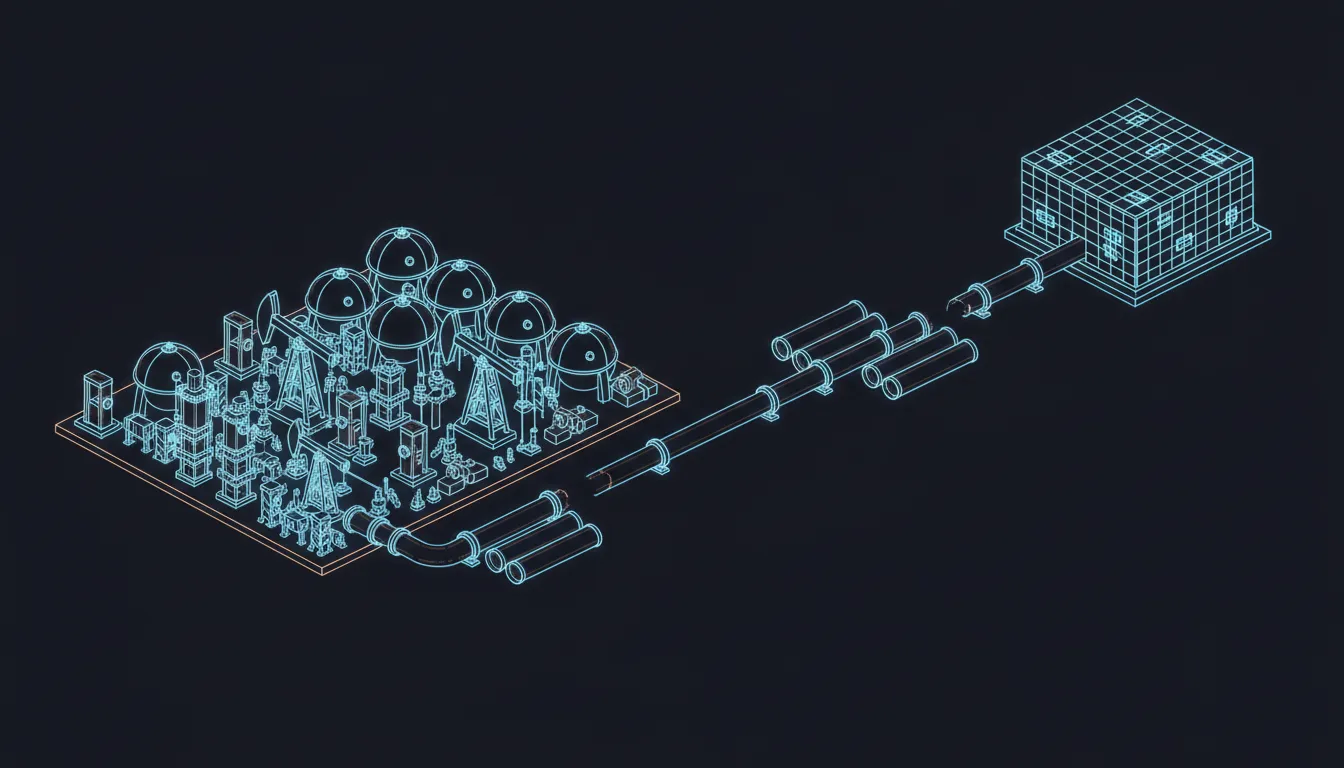
The gas pipes behind AI power: what this week's reports tell you to watch
The latest gas reports show two clocks running at once. Majors and producers are posting strong quarters now, while new pipelines are being planned for 2030 and later.
The read in plain words
This week's gas reports all point the same way. The companies that produce, move and sell natural gas are building for a long horizon, and the near-term numbers give them room to do it. Kinder Morgan's third-quarter call was mostly about pipelines that come online in 2030 and later.3 In the same week Chevron and Exxon Mobil reported large quarters4,5 and EQT announced a deal to buy Range Resources.2
This matters for the AI build-out because data centers need firm power, and some of that power is now contracted directly from energy companies. The clearest example in our facts is Chevron's 20-year take-or-pay agreement with Microsoft for 2.67 gigawatts of firm behind-the-meter capacity.6 Behind-the-meter means the power is produced on site or next to the user instead of being drawn from the grid.
Our view: the supply chain behind that power is being decided on calls and in deal announcements right now, years before the steel goes in the ground. The rest of this piece covers what each report said and what would show the plans are holding.
Kinder Morgan: pipes for the 2030s
$KMI, whose Q3 FY2026 call was about new gas transport capacity, gave the longest-dated story of the week. Its Permian Link project adds 2.8 Bcf per day of takeaway and comes online in 2030.1 Takeaway is pipeline capacity that carries gas out of a producing basin to the places that use it. Bcf per day means billion cubic feet per day.
The Southeast Connector project includes the Greenfield line up to the Nashville area. It comes online in stages over 2030, 2031 and 2032.3 Greenfield means a new line on a new route, which usually takes longer and carries more permitting risk than expanding a line that already exists.
The company also put a cost on one piece. TGP 219 South is estimated at $1.5 billion of CapEx for the brownfield component, with a higher cost if it is scaled to 2-3 Bcf per day.7 Brownfield is the opposite of greenfield: building on existing routes and assets.
For investors, the point is timing. These are commitments to demand that the company expects several years out. Each project's progress through permitting and contracting will show whether that expected demand is firming up.
EQT: scale on the supply side
Producers are reorganising at the same moment. EQT announced a strategic acquisition of Range Resources and describes the result as America's largest and only vertically integrated natural gas producer.2 Vertically integrated means one company owns more of the chain from the wellhead to the pipeline, rather than handing gas to a third party.
The quarter itself showed spending discipline. EQT reported Q3 2026 capital expenditures of $638 million, 10% below the low end of its guidance.8 It expects maintenance capital expenditures of $540 - $610 million in Q4 2026.9 Maintenance capex is what it costs to hold production flat, before spending on growth.
EQT is second in our data. Taken together, the deal and the capex figures describe a producer adding scale while keeping costs in check, which is the supply-side half of the pipeline story above. The next checkpoint is whether Q4 spending lands inside that guided range.
Chevron and Exxon: strong quarters, and a power deal
The majors reported on Oct 30. Chevron reported third-quarter 2026 earnings of $9.9 billion.4 One headline read: "Chevron Exceeds Forecasts on Oil Prices, Swollen Fuel-Making Returns".10 Another said both companies' earnings were driven by a surge in refining.11 That points to a strong quarter for converting crude into fuels.
Exxon Mobil published its third-quarter 2026 results12, with adjusted earnings of $17.5 billion.5 On its earlier call the company described production that is spread globally at scale and built on durable advantages, which it said gives it a platform to create value through price cycles and market disruptions.13 It also pointed to expertise in extended-reach laterals in the Permian Basin, with over 1,200 wells drilled longer than 3 miles since 2020.14
Chevron, which leads our score, has the most direct AI link in our facts: the Microsoft power agreement.6 Separately, the company says it is working on advanced chemicals and AI technologies to get more value from its assets.15 Exxon Mobil is third in our data.
One smaller item: Reuters reported that Exxon and Chevron cancelled executive trips to the ADIPEC conference, citing sources.16 The facts give no reason for the cancellations, so we note it and draw no conclusion.
How to think about it, and what to watch
A useful way to read this sector is as two layers that move at different speeds. Producers and majors report every quarter, and their numbers respond quickly to refining and pricing conditions.11 Pipelines like Permian Link are judged over years, against in-service dates such as 2030.1
There are three things worth tracking. First, whether Kinder Morgan's projects keep their 2030 to 2032 timelines and whether the TGP 219 South scope moves toward the larger 2-3 Bcf per day case.3,7 Second, how the EQT and Range Resources combination progresses, and whether Q4 maintenance capex stays inside $540 - $610 million.2,9 Third, whether more power agreements like Chevron's with Microsoft appear, because they show demand from AI customers in the most concrete form available.6
If those markers hold, the long-dated pipeline plans and the near-term producer discipline describe the same build-out from two ends. Each new quarter will give a clearer read on whether they line up.
What would change our view
- Kinder Morgan pushes Permian Link or the Southeast Connector beyond the stated 2030 to 2032 windows.3,1
- The EQT and Range Resources combination does not go ahead as announced.2
- EQT's Q4 maintenance capex comes in outside the guided $540 - $610 million range.9
- No new long-term power agreements like Chevron's 2.67 gigawatt deal with Microsoft follow.6
If you buy or contract gas capacity, are data center power deals already shaping your pipeline and supply negotiations, or is that still years away?
Answer on XSources
- 1Earnings call KMI FY2026 Q3, transcript, Oct 21, 2026.
- 2Industry research note, research note, Oct 27, 2026.
- 3Earnings call KMI FY2026 Q3, transcript, Oct 21, 2026.
- 4Industry research note, research note, Oct 30, 2026.
- 5Industry research note, research note, Oct 30, 2026.
- 6Earnings call CVX FY2026 Q2, transcript, Jul 31, 2026.
- 7Earnings call KMI FY2026 Q3, transcript, Oct 21, 2026.
- 8Industry research note, research note, Oct 27, 2026.
- 9Industry research note, research note, Oct 27, 2026.
- 10Benzinga, news, Oct 30, 2026.
- 11CNBC, news, Oct 30, 2026.
- 12Company release, news, Oct 30, 2026.
- 13Earnings call XOM FY2026 Q2, transcript, Jul 31, 2026.
- 14Earnings call XOM FY2026 Q2, transcript, Jul 31, 2026.
- 15Earnings call CVX FY2026 Q2, transcript, Jul 31, 2026.
- 16Reuters, news, Oct 29, 2026.
For information only. Not investment advice.
Related research
All research →
Why copper refuses to die, and who gets paid while it lives
One research note calls copper dead; the same month Credo is stretching copper links to 30 meters and Marvell says it plans to intercept copper-based solutions. The disagreement is the trade story.
Co-packaged optics is being scheduled, not debated
Six companies across memory, networking, lasers and foundry have now put dates on moving light into the package. The timeline runs from qualified lasers today to a 2028 foundry ramp.
Welding is getting busier: what the latest calls say about process tooling
The latest reports from welding and dispensing suppliers show volume and orders starting to do more of the work than price. Here is what Lincoln Electric, Graco, ITW and Nordson said, and what to watch next.