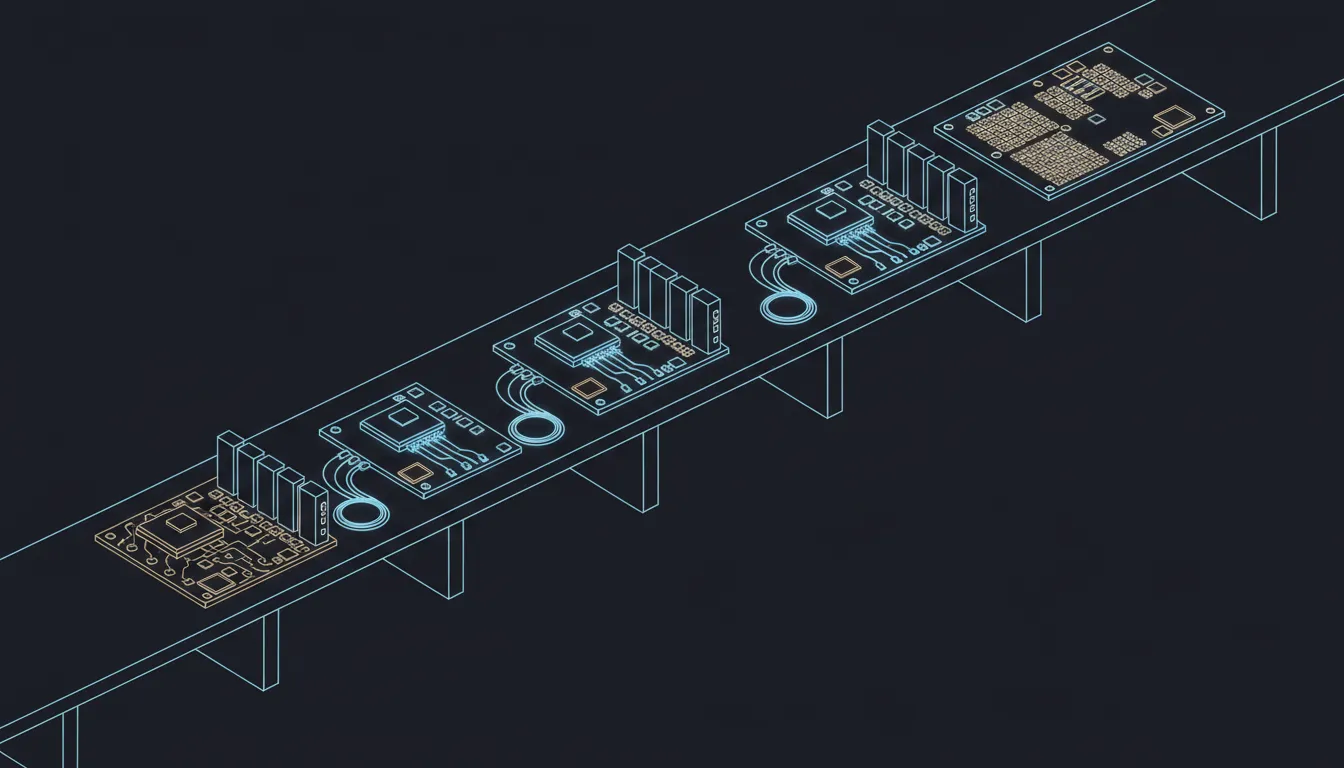
Co-packaged optics is being scheduled, not debated
Six companies across memory, networking, lasers and foundry have now put dates on moving light into the package. The timeline runs from qualified lasers today to a 2028 foundry ramp.
The short explanation of what CPO is, and why it showed up now
Co-packaged optics means putting the optical engine that turns electrical signals into light inside the same package as the switch or accelerator chip, instead of in a pluggable module at the front of the box. The point is distance and power: electrical links run out of room before the bandwidth does.
What changed is not the physics but the calendar. Across the last two earnings seasons and two industry research notes, six companies in different parts of the chain have attached dates, qualifications or product architecture to CPO rather than describing it as a direction of travel.
Memory is the newest entrant to that conversation. SK Hynix published a co-packaged optics roadmap in Nature Electronics, mapping the path from memory bandwidth to optical interconnect.1 That roadmap was still being cited in industry research a month later.7
Why the memory angle matters for Micron
Micron Technology ($MU) makes memory. The SK Hynix roadmap is the fact in this set that carries Micron's file, and it is worth being precise about why: it is a competitor's published research, not a Micron product announcement.1
The reason it lands on the memory side at all is the framing of the roadmap itself — the path runs from memory bandwidth to optical interconnect.1 That is an argument that the bottleneck being solved by optics is, at least in part, a memory bottleneck.
For a reader following memory, the useful read is that the optical conversation has stopped being confined to switches and transceivers. When a memory maker publishes the roadmap in a peer-reviewed journal, the interconnect question is being treated as architectural rather than peripheral.1
The lasers are qualified before the systems are shipping
The nearest-term evidence sits at the component layer. Applied Optoelectronics, which makes optical components, has qualified several customers for 1.31 thousand-nanometer CPO lasers and ELSFPs.4 Qualification means a customer has tested the part and accepted it into a design — it precedes revenue rather than confirming it.
Coherent, another optical components supplier, is qualified or has line of sight to qualify for CPO laser revenues.5 Two suppliers describing qualification at roughly the same time is the clearest signal in this set that the laser side of CPO is further along than the system side.
That ordering is normal for optics and it matters for how the next year reads. Lasers get designed in first; the switch and package integration that consumes them arrives later.
So a quarter with no CPO system revenue is not evidence the program slipped. The component qualifications are the leading indicator here.4,5
The system dates: 2027, then 2028
Astera Labs, which makes connectivity silicon for AI systems, expects to enter volume production in 2027 with a tier 1 AI platform provider for high-density fiber-attached solutions.2 That is a company-stated plan tied to a named customer tier, and it is the earliest volume date in this set.
GlobalFoundries, a contract chip manufacturer, expects to begin ramping CPO in 2028.3 A foundry ramp date is a different kind of commitment from a product date: it implies capacity being allocated to the process, and it sits a year behind Astera's stated volume year.2,3
If both hold, the sequence is components qualified in 20264,5, one volume platform in 20272, and foundry-scale manufacturing from 20283. Neither company has to be right for the shape to be useful — it tells you which year to test each claim in.
Arista's open interface is the variable that decides who captures the value
Arista Networks, which builds data-center networking switches, is working on open CPO with socketed optical engines and pigtail fibers for pretested modules, aiming for a truly open interface that can operate with multiple vendors and switch configurations.6
Three words in that do a lot of work. Socketed means the optical engine can be removed and replaced rather than soldered down — it addresses the repairability objection that has held CPO back in operations. Pretested modules means the optical part is verified before it meets the expensive switch die, which is a yield argument. And open, across multiple vendors, is a competitive argument.6
An open, socketed interface would keep the optical engine a contestable component rather than a captive one. That is directly relevant to the two laser suppliers whose qualifications are already in hand4,5, and it is the difference between CPO being a closed platform feature and a supply chain with several sellers.
Nothing in these facts says the open approach wins. It says one of the largest switch vendors is building toward it.6
How to read the next several quarters
The honest summary is that CPO has moved from architecture papers to calendars, and the calendars disagree by about a year.2,3 That gap is where the useful questions sit.
Three things are checkable without any forecasting. Whether AOI's qualified customers convert to shipped volume4; whether Coherent's line of sight to CPO laser revenue becomes recognised revenue5; and whether Astera's 2027 volume language holds or moves in future calls.2
The memory thread is the slowest-moving and possibly the largest. A published roadmap from memory bandwidth to optical interconnect is a statement about where the next generation of systems gets built, and it will show up in product form long after it showed up in print.1
What would change our view
- A slip in Astera Labs' stated 2027 volume production date, or a change in the tier 1 platform relationship behind it.2
- GlobalFoundries moving its 2028 CPO ramp, in either direction — a foundry date is the capacity signal in this set.3
- AOI's qualified CPO laser customers failing to convert to shipped volume, or Coherent's line of sight to CPO laser revenue not closing.4,5
- Arista's open CPO effort being abandoned for a closed, vendor-specific interface, which would change who can sell the optical engine.6
If CPO lasers are already qualified but the foundry ramp is a 2028 event, which do you weight more in the meantime — the component qualifications or the system dates?
Answer on XSources
- 1Industry research note, research note, Aug 20, 2026.
- 2Earnings call ALAB FY2026 Q2, transcript, Dec 31, 2027.
- 3Earnings call GFS FY2026 Q2, transcript, Jan 1, 2028.
- 4Earnings call AAOI FY2026 Q2, transcript, Aug 6, 2026.
- 5Industry research note, research note, Sep 24, 2026.
- 6Earnings call ANET FY2026 Q2, transcript, Aug 4, 2026.
- 7Industry research note, research note, Sep 24, 2026.
For information only. Not investment advice.
Related research
All research →
The gas pipes behind AI power: what this week's reports tell you to watch
The latest gas reports show two clocks running at once. Majors and producers are posting strong quarters now, while new pipelines are being planned for 2030 and later.
Why copper refuses to die, and who gets paid while it lives
One research note calls copper dead; the same month Credo is stretching copper links to 30 meters and Marvell says it plans to intercept copper-based solutions. The disagreement is the trade story.
Welding is getting busier: what the latest calls say about process tooling
The latest reports from welding and dispensing suppliers show volume and orders starting to do more of the work than price. Here is what Lincoln Electric, Graco, ITW and Nordson said, and what to watch next.