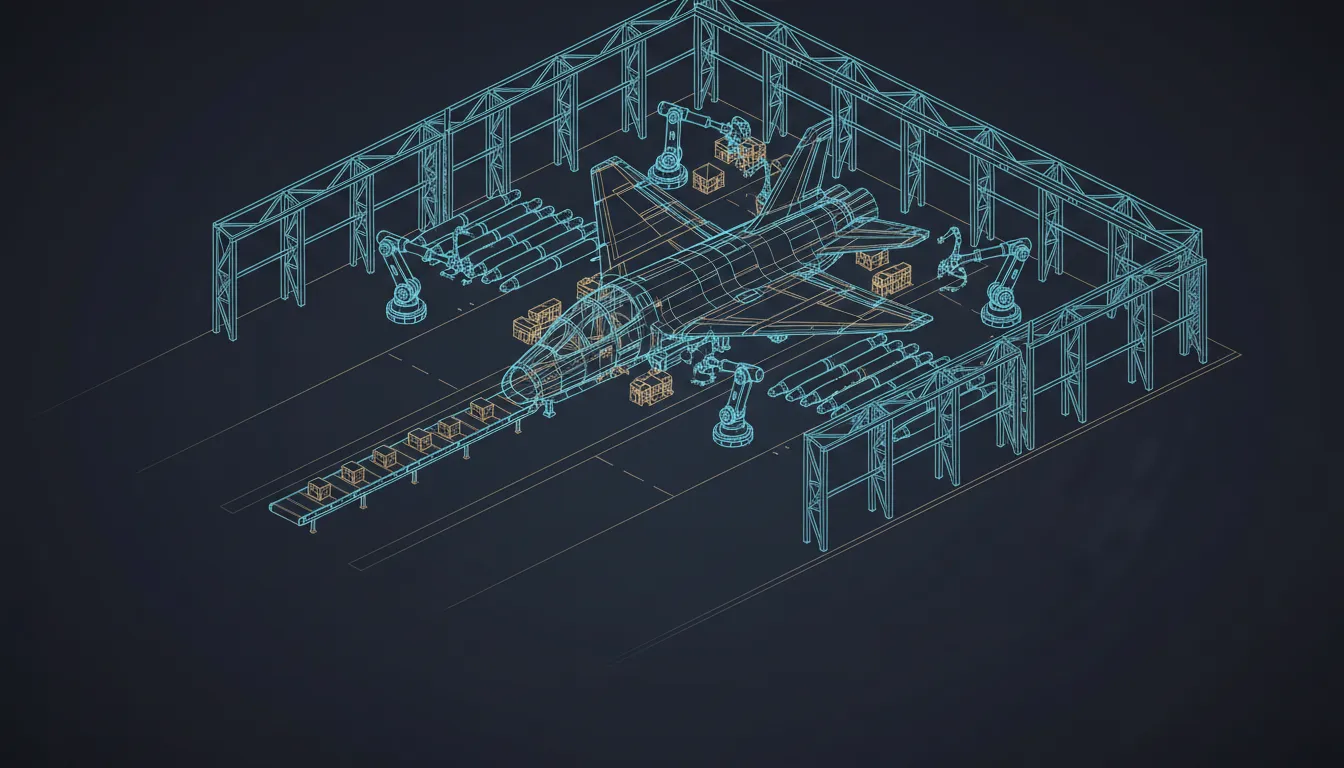
The capacity squeeze in defense and aerospace, and who is building their way out
On the latest earnings calls, the companies that sounded strongest were talking about floor space, automation and supply chains, not demand. Here is what they said, and what to watch as those plans meet reality.
The read: capacity is the constraint
The latest round of defense and aerospace earnings calls kept coming back to supply. The companies sounding most confident weren't describing new demand. They were describing new buildings, new lines and work they're bringing in-house. The question for investors has moved from whether there are orders to who can actually build them.
L3Harris is adding almost 1 million square feet of missile production capacity in new, highly automated facilities.1 Leonardo DRS is adding capacity for tactical radar and revitalizing its foundry for next-generation infrared sensors.5 Boeing laid out a path to higher 737 output and, in the same breath, expects supply chain constraints at rates above 52 a month.6,4
That's the spine of this piece. Where capacity is being built, the plan is the story. Where it isn't, the supply chain sets the pace. In our data, Axon Enterprise leads, L3Harris is second and Leonardo DRS is third, and each lines up differently against that constraint.
L3Harris: building the factory, with robots inside it
L3Harris is the clearest case of a prime turning capacity into a strategy. Its missile expansion runs to almost 1 million square feet of new, highly automated facilities.1 The company says it is building 60 buildings for missiles alone.3
This is also where the robotics thread comes in. L3Harris says it uses AI and advanced automation in missile production, including robotics that move motors from station to station.7 Put simply, it isn't just adding floor space. It's trying to change how many people and hours each unit takes, which matters when the limit is throughput rather than orders.
L3Harris ranks second in our data. If the new buildings come online on the company's plans, it is one of the few names that can point to physical capacity as the answer to the supply question. The thing to track is how fast that space turns into output.
Leonardo DRS: sensors, radar and a yard of its own
Leonardo DRS is a defense-technology company, listed in an industry research note on its Munitions & Effectors panel.8 Its capacity story centers on the electronics that make systems see: tactical radar, where it's adding production capacity, and infrared sensors, where it's revitalizing its foundry for the next generation.5
The second leg is insourcing. DRS says its Charleston facility is nearing completion for insourcing Columbia-class submarine work.9 The company expects Phase 1 to drive margin uplift in the second half of 2027.9
That timing matters. DRS is third in our data, and part of its story is a margin step the company expects more than a year out. If Charleston hits its marks, insourcing turns a supply dependency into a profit lever. If it slips, that uplift slips with it.
Axon: the software name with pricing power
Axon Enterprise (AXON) sits a little apart from the factory-floor story, and that's partly why it leads our score. The company calls Axon Evidence the backbone of its software business and the secure data foundation of its broader vision.10 Software doesn't need 60 buildings to grow, so Axon avoids the bottleneck its peers are spending to clear.
What it does report is demand. Axon's five-year normalized bookings grew over 30% year-over-year, and the company expects a massive second half with bookings in the 30% range.11,2 Management credits network effects and ecosystem integration for strong pricing power.12
Network effects here mean each new user or connected product makes the platform more useful to the next one, which makes customers stickier and pricing easier to hold. If that holds, Axon's growth runs on customer demand rather than how fast it can add capacity. That's the contrast with the hardware names in this group.
The shared limit: what Boeing and Textron show about supply
Commercial aerospace shows what happens when demand outruns supply. Boeing plans to take its 737 production rate from 47 to 52 a month, then to 57 and potentially 63.6 It also expects supply chain constraints above 52 a month.4 On the 787, Boeing plans a rate increase and is working with GE on engine deliveries.13
Textron gives a quarter's worth of actual output. Textron Aviation delivered 40 jets and 44 commercial turboprops in Q2 FY2026, and Bell delivered 36 helicopters.14,15 Delivery counts like these are where capacity talk turns into units.
The lesson carries over to defense. A plan to build more is only as good as the slowest supplier in the chain. That's why the names building and automating their own capacity, or skipping the physical constraint entirely, stand out in our data.
What to watch next
The useful way to follow this theme is to watch plans turn into output. For L3Harris, that means the automated missile facilities going live and showing up in production.1 For Leonardo DRS, it's the Charleston Phase 1 timeline and the margin uplift the company expects in the second half of 2027.9
For Axon, the test is whether second-half bookings land in the 30% range the company expects.2 For the wider sector, Boeing's 737 rate moves above 52 a month are a live read on the supply chain.4
None of this calls for a prediction. It calls for checking each company's capacity plan against its next report. The names that deliver on their buildings, lines and bookings will tell the story themselves.
What would change our view
- L3Harris's new automated missile facilities falling behind schedule or not lifting output.1
- Delays at Leonardo DRS's Charleston facility that push the Phase 1 margin uplift past the second half of 2027.9
- Axon's second-half bookings coming in well short of the 30% range the company expects.2
- Supply chain limits spreading from Boeing's 737 rates above 52 a month into defense suppliers.4
If you build or buy defense or aerospace hardware, where does the bottleneck sit right now: floor space, skilled labor or a specific component supplier?
Answer on XSources
- 1Earnings call LHX FY2026 Q2, transcript, Jul 29, 2026.
- 2Earnings call AXON FY2026 Q2, transcript, Aug 5, 2026.
- 3Earnings call LHX FY2026 Q2, transcript, Jul 29, 2026.
- 4Earnings call BA FY2026 Q2, transcript, Jul 28, 2026.
- 5Earnings call DRS FY2026 Q2, transcript, Jul 30, 2026.
- 6Earnings call BA FY2026 Q2, transcript, Jul 28, 2026.
- 7Earnings call LHX FY2026 Q2, transcript, Jul 29, 2026.
- 8Industry research note, research note, Oct 3, 2026.
- 9Earnings call DRS FY2026 Q2, transcript, Jul 30, 2026.
- 10Earnings call AXON FY2026 Q2, transcript, Aug 5, 2026.
- 11Earnings call AXON FY2026 Q2, transcript, Aug 5, 2026.
- 12Earnings call AXON FY2026 Q2, transcript, Aug 5, 2026.
- 13Earnings call BA FY2026 Q2, transcript, Jul 28, 2026.
- 14Earnings call TXT FY2026 Q2, transcript, Jul 28, 2026.
- 15Earnings call TXT FY2026 Q2, transcript, Jul 28, 2026.
For information only. Not investment advice.
Related research
All research →
Welding is getting busier: what the latest calls say about process tooling
The latest reports from welding and dispensing suppliers show volume and orders starting to do more of the work than price. Here is what Lincoln Electric, Graco, ITW and Nordson said, and what to watch next.

Surgical robots: who is gaining ground, who is defending it, and why it matters to you
In medical robotics, share is won by getting a system into the hospital and keeping the work flowing through it. The latest earnings calls show incumbents defending that position while challengers come in through new systems, other procedures and new regions.

Surgical robots have a supply problem: where capacity, not demand, sets the pace
On the latest earnings calls, medical device makers talked less about finding buyers and more about building, shipping and stocking enough product. Who solves supply first is the story to follow.