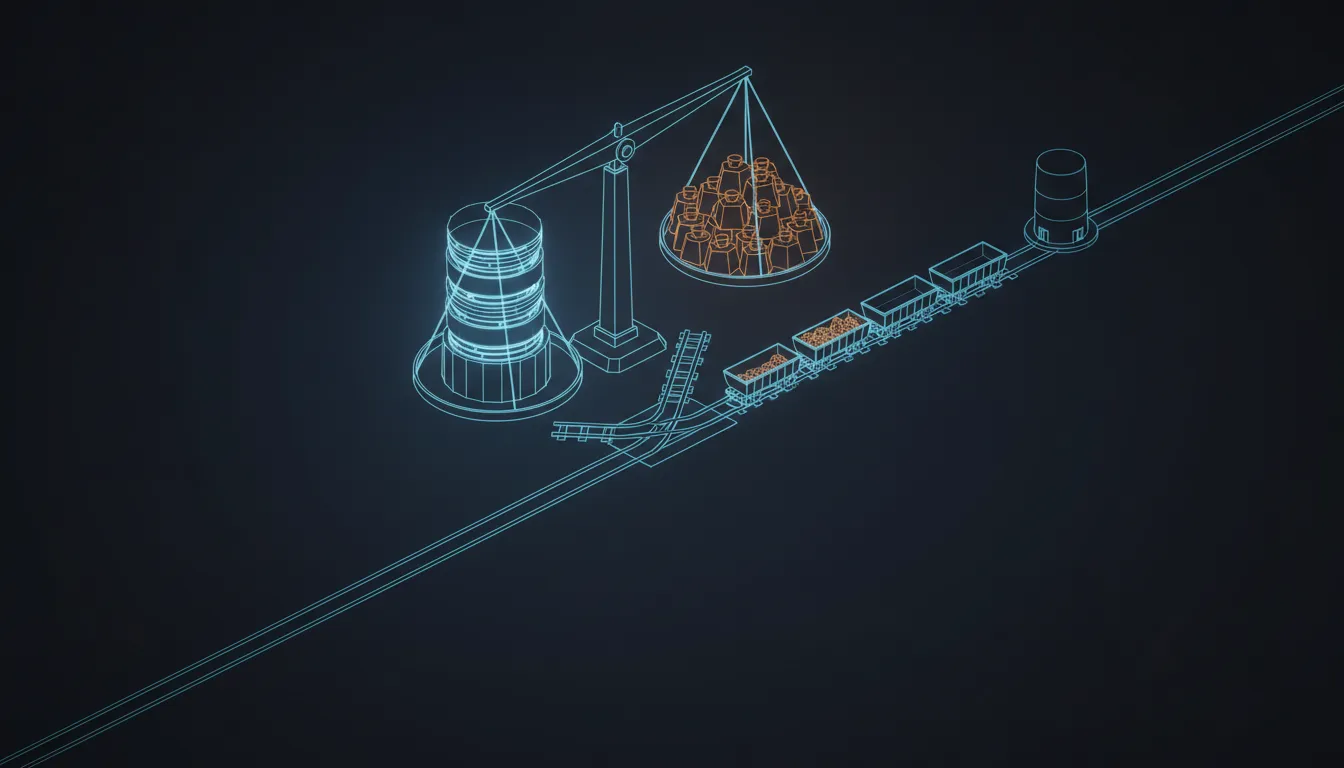
The AI IPO test: what a $1.5 trillion Anthropic listing has to prove
The fear around Anthropic and OpenAI is mostly about a credit event spilling into public markets. The latest reports point somewhere else: valuation expectations, how much capital these companies are raising, and customers who can switch providers.
The read in plain words
Anthropic is reportedly targeting a November IPO.1 The valuation being discussed is roughly $1.5 trillion.2 Some investors expected something closer to $2 trillion.3
That gap matters more than a default does. A listing below what early backers hoped for resets private-market expectations. It is not, in itself, a sign of credit stress, and nothing in these reports describes a missed payment or a lender pulling back.
So in our view the useful question is not whether these companies blow up. It is whether the prices paid in private rounds hold up once public investors set the price every day.
Two valuations, one benchmark
Anthropic builds AI models that other companies run inside their products, and it also sells subscription plans.5,6 One recent industry note found Anthropic's subscription plans offer better value than OpenAI for Opus 5.5.6 That points to a company competing on price as well as on model quality.
OpenAI, which makes ChatGPT, has been raising on a very large scale.5 It raised $122B in committed capital earlier this year and is discussing another round at more than a $1.2T valuation.4
Put the two together and you have the yardstick public investors will probably use. If OpenAI's next private round prices above $1.2T, that shapes how Anthropic's roughly $1.5T is judged.2,4 A public listing is where that comparison stops being theory and gets a daily price.
Where the money goes: from tenant to builder
OpenAI's Stargate project marks a shift from renting AI data center capacity to co-developing it, and OpenAI is now shaping power and infrastructure planning directly.7 A co-developer carries more of the build than a tenant does.
That is why the size of the capital raise matters. Committed capital of $122B, plus talks about a new round, is the kind of money an infrastructure role calls for.4 The plans make sense if the demand behind them holds. If it slips, the commitments stay, and that is where a credit worry would actually start.
For public-market investors, the link to watch runs from these private balance sheets to the companies building the data centers and supplying power. The reports here describe OpenAI's role changing, not any strain in paying for it.7
The real pressure point: customers can switch
Replit, whose Replit Agent runs on a third-party AI model, has moved its default from Anthropic's models to OpenAI's ChatGPT.5 Replit gave performance, cost and partnership as its reasons.8
That is a small item with a big meaning. Developer tools that sit on top of these models can change the default model behind them, and all three of Replit's reasons can be fought over. Cost is one Anthropic seems to compete on, given the subscription-value finding.8,6
For an IPO, losing customers matters more than any single headline. Public investors pay for revenue that keeps coming back. A pattern of high-profile defaults moving between providers would weigh on any company's valuation, Anthropic's or OpenAI's.
How to think about the spillover question
The worry that a weak AI IPO could set off a credit event and drag public markets down needs several steps to happen in a row. The listing would have to disappoint. The disappointment would then have to show up in financing. And financing trouble would have to hit the companies building the infrastructure. The reports so far cover only the first step, a range of valuation expectations between roughly $1.5T and closer to $2T.2,3
So there are three things to watch, in order. First, the final pricing and timing of the Anthropic IPO against its reported November target.1 Second, whether OpenAI closes its round above $1.2T.4 Third, whether more customers follow Replit in switching their default model, and in which direction.5
If all three come through, the IPO works as a reality check that simply confirms the private marks. If they weaken together, expectations get repriced, and the infrastructure plans tied to Stargate become the place to look for strain first.7 Either way, these are things investors can track as they happen, not something left to guesswork.
What would change our view
- The Anthropic IPO slipping past its reported November target, or the discussed valuation moving well away from roughly $1.5T.2,1
- OpenAI's round at more than $1.2T failing to come together after $122B committed earlier this year.4
- More developer platforms following Replit in switching their default model, which would make customer switching a pattern rather than a one-off.5
- Evidence that the Stargate infrastructure commitments are putting strain on OpenAI's financing.7
If you build products on these models, what would it take for you to switch your default provider the way Replit did: performance, cost or the partnership?
Answer on XSources
- 1Industry research note, research note, Oct 20, 2026.
- 2Industry research note, research note, Oct 21, 2026.
- 3Industry research note, research note, Oct 21, 2026.
- 4Industry research note, research note, Oct 1, 2026.
- 5Industry research note, research note, Oct 17, 2026.
- 6Industry research note, research note, Oct 5, 2026.
- 7Industry research note, research note, Oct 12, 2026.
- 8Industry research note, research note, Oct 16, 2026.
For information only. Not investment advice.
Related research
All research →
The closed-weight AI race: where Anthropic is gaining and OpenAI is defending
October's industry notes put the competition among closed-weight labs in sharper focus. Anthropic leads in coding, OpenAI is defending on trust and value, and smaller labs are pushing into decision models.
Welding is getting busier: what the latest calls say about process tooling
The latest reports from welding and dispensing suppliers show volume and orders starting to do more of the work than price. Here is what Lincoln Electric, Graco, ITW and Nordson said, and what to watch next.
Liquid biopsy's quiet bottleneck: who is building lab capacity first
Three diagnostics companies used their latest earnings calls to talk about labs, automation and cost per test. In this corner of health care, capacity may matter as much as demand.